Watch@Heart. Detecting heart rhythm disorders early with data from wearables: five years long, without a daily action from the participant.

five years
in view

“A five-year study stands or falls with participants who keep going. So the design did not start with the sensors, but with the question of what a patient does not want to do for five years.”

Eduard van Pagée · Researchable

People with an inherited heart muscle disease see their cardiologist once or twice a year. What the heart does in the months in between stays out of view.
For Watch@Heart, a research project run by the cardiology department of Amsterdam UMC, we built the platform that does measure those months, together with Sport Data Valley: five years long, through participants' Apple Watch and iPhone.
In short
- Watch@Heart measures the hearts of people with an inherited heart muscle disease for five years outside the consulting room, through an Apple Watch and an app that runs in the background.
- Participants do almost nothing themselves: two questionnaires a year and one short ECG a month.
- Researchers track wear time, completion rates and abnormal values in a single dashboard inside Sport Data Valley.
- All data sits on Amsterdam UMC's servers, GDPR-compliant and developed to ISO 27001:2022.

A heart centre measuring five years ahead
The cardiology department of Amsterdam UMC studies inherited cardiomyopathies: heart muscle diseases with a shared genetic basis, a lasting risk of heart failure and arrhythmia, and a course that differs from person to person.
Watch@Heart is a randomised study led by Prof. Folkert W. Asselbergs. Half of the participants receive usual care; the other half also receive an Apple Watch and an app that run alongside it for five years. Sport Data Valley provides the environment in which the researcher dashboard runs.
From snapshot to continuous picture
A check-up describes the heart on a single morning. The episodes in between are missing from the classic dataset.
A hospital check-up is thorough: a twelve-lead ECG, an exercise test, an echo, and an MRI at the start. But that check-up describes the heart on that one morning. About the months before and after, it says little.
A period of atrial fibrillation that starts at home and is over before the next appointment does not appear in the classic dataset. Those are exactly the episodes the research team wants to see, along with new predictors of acute clinical deterioration.
“The scientific value of measuring for five years lies in the data you do not miss. An arrhythmia that starts at home and is over before the next check-up simply does not exist in a classic dataset.”
 Frank Blaauw · Managing Director Researchable
First things first: the participant before the sensor
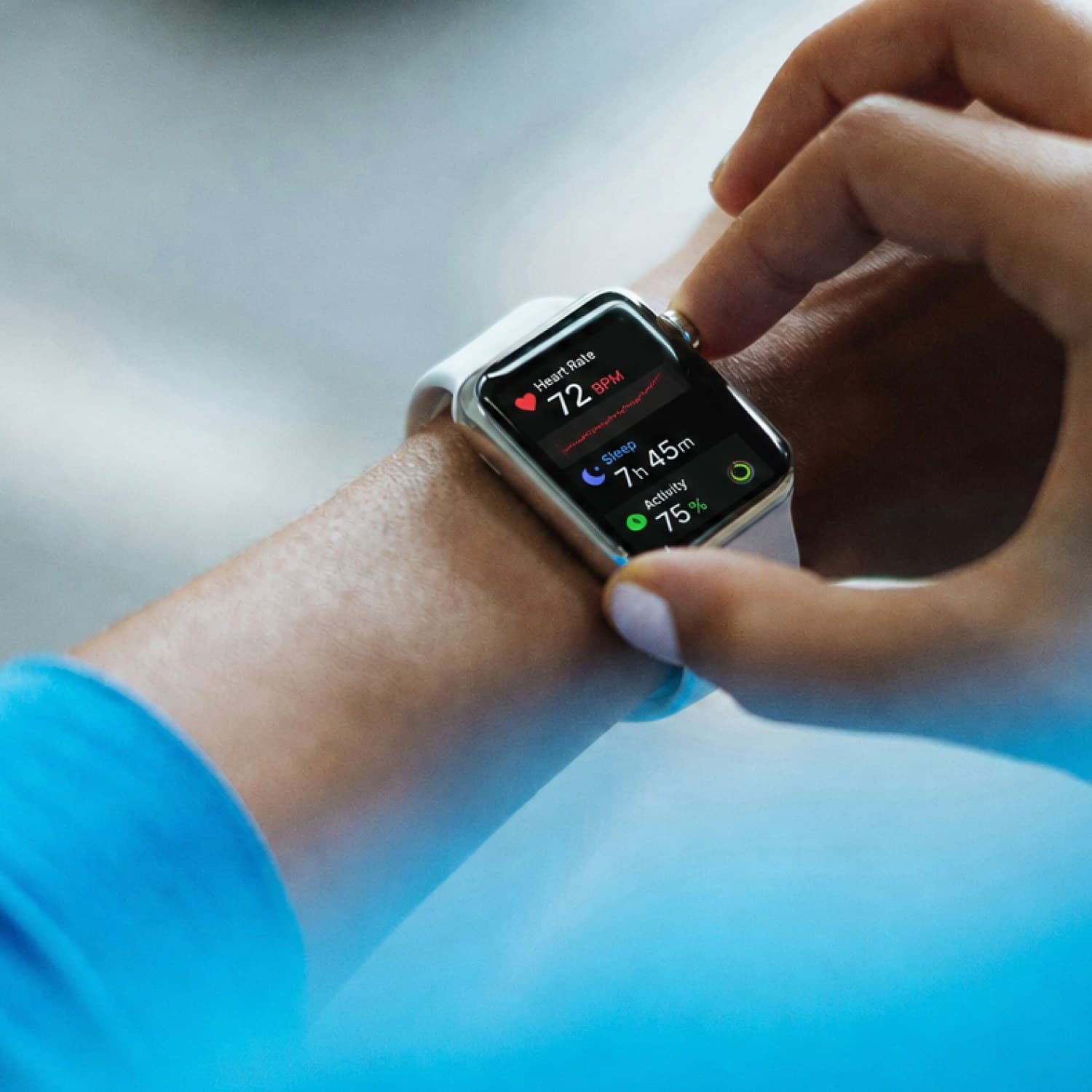
Every extra measurement costs battery, and every time the watch has to go on the charger is a moment where someone might drop out. That is why the app runs in the background. Participants start nothing and track nothing: two questionnaires a year and one short ECG a month are the only actions.
The watch measures on a fixed schedule: one measurement day a month with a short heart rhythm reading every hour, plus readings after exertion. Once a week the app collects the health data the watch keeps itself: heart rate, variability, sleep, respiration. Participants give separate consent for each source; messages and location stay outside the study.
“The measurement protocol is as much a design for compliance as a technical design. Every measurement we added was weighed against the question of whether someone would still be wearing this in three years.”
One dashboard instead of loose sensor files
One dashboard inside Sport Data Valley: wear time, questionnaires, alerts and the link to the patient record.
Researchers follow the study in a dashboard inside Sport Data Valley: average wear time, the share of completed questionnaires and ECGs, and an alert list that puts participants with abnormal values at the top. Questionnaires are scheduled from the same screen; anyone who forgets gets an automatic text message.
Through a link with the patient record, the system measures more intensively for two days before and after every check-up. All data sits on Amsterdam UMC's secure servers, accessible only to the research team. GDPR-compliant and developed to ISO 27001:2022.
“We built the route from the watch to the server and the screen the researcher looks at. The data itself sits with Amsterdam UMC and does not leave there.”
Eduard van Pagée · ResearchableFirst the dataset, then the prediction
The study is building a dataset in which measurements from everyday life sit alongside clinical measurements. On top of that, the research team wants to build prediction models for clinical deterioration, once there are enough years of data.
In a follow-up phase the dashboard becomes generic, so other research groups inside Sport Data Valley can use it for their own studies with wearables. The principal investigator is Prof. Folkert W. Asselbergs, Amsterdam UMC.

The results at a glance
Five years of measuring without a daily action
The app runs in the background. Two questionnaires a year and one short ECG a month are the participant's only actions.
Consulting room and everyday life in one dataset
Around every check-up the system measures more intensively for two days. That happens automatically, through the link with the patient record.
The hospital keeps control of the data
The data sits on Amsterdam UMC's servers, accessible only to the research team. GDPR-compliant, developed to ISO 27001:2022.
Frequently asked questions
What is Watch@Heart?
Watch@Heart is a randomised study by the cardiology department of Amsterdam UMC, led by Prof. Folkert W. Asselbergs. The study follows people with an inherited heart muscle disease for five years. Half of the participants receive usual care; the other half also receive an Apple Watch and an app that run alongside it for five years.
What does a participant have to do?
Almost nothing. The app runs in the background and collects the data itself. Twice a year the participant fills in a questionnaire, and once a month they record a short ECG with the watch. Nothing else has to be started or tracked.
What data does the watch measure?
Heart rate, heart rhythm through a short ECG, heart rate variability, sleep, respiration and movement. The watch measures on a fixed schedule: one measurement day a month with a short heart rhythm reading every hour, plus readings after exertion. Participants give separate consent for each data source; messages and location stay outside the study.
Where is the data stored and who can access it?
All data sits on Amsterdam UMC's secure servers and is accessible only to the research team. Researchable built the route from the watch to the server and the screen the researcher looks at, but does not manage the data. The platform is GDPR-compliant and developed to ISO 27001:2022.
Why five years and not shorter?
An inherited heart muscle disease runs differently in every person and develops slowly. A six-monthly check-up only shows how the heart is doing on that one morning. Only over several years does a dataset emerge in which episodes from everyday life sit alongside clinical measurements: the basis for prediction models for clinical deterioration.