
As AI increasingly makes decisions with direct impact, explainability is no longer a luxury but a necessity. How Explainable AI builds trust and transparency.
In brief
- AI systems that decide on mortgages, fraud detection and diagnoses often work as a 'black box', which creates distrust and compliance problems.
- Together with Hogeschool Utrecht, Floryn and De Volksbank, Researchable developed a whitepaper with an XAI checklist across three levels: organisation, use case and monitoring.
- Different stakeholders ask for different explanations: from simple customer communication to detailed technical documentation for regulators.
- Explainability is not a one-off action but a continuous process, and the approach applies far more widely than the financial sector alone.

There is an old Dutch saying: "Trust arrives on foot and leaves on horseback." This wisdom applies not only to human relationships, but is becoming increasingly relevant in how we deal with technology. Now that AI systems play an ever larger role in important decisions, from credit applications to medical diagnoses, understanding this technology is no longer a luxury but a necessity.
Why transparency in AI has become indispensable
AI systems increasingly make decisions that have a direct impact on our daily lives. Think of approving a mortgage, detecting fraud in financial transactions or even making a medical diagnosis. But what happens when these systems make a decision we do not understand? Or worse, a decision that is biased or incorrect? This is where Explainable AI (XAI) comes in. XAI is not a fashionable term or a passing trend; it is the key to responsible innovation in a world that is becoming ever more dependent on artificial intelligence.
From black box to glass house: the challenge of modern AI
Modern AI models, especially deep learning systems, are known for their complexity. These so-called 'black boxes' can deliver impressive results, but the process behind their decision-making often remains opaque.
This lack of transparency can lead to:
- Distrust among end users who cannot verify decisions
- Compliance problems with new regulation such as the AI Act
- Limited scope for professionals to detect and correct errors
- Missed opportunities to improve models further based on insights
A practical approach: the XAI checklist for the financial sector

At Researchable, we took the lead in tackling this challenge a few years ago. In collaboration with Hogeschool Utrecht, Floryn and De Volksbank, and with support from the Taskforce for Applied Research SIA, we developed an extensive whitepaper on XAI specifically for the financial sector. The result? A practical checklist that helps developers and data scientists integrate explainability into every phase of the AI process:
1. Organisation level
This covers guidelines for the general XAI philosophy and governance within the organisation. Key control points include:
- Setting out values and principles around XAI and explainability
- Developing processes for the design, development, assessment and monitoring of XAI systems
- Mapping out the relevant laws and regulations for transparency and explanation
2. Use case level
This level zooms in on the concrete application of XAI per project phase:
- Business & Understanding Data: determining the desired levels of transparency and explanation, the risks and the objectives of the AI model
- Model Development: choosing the type of AI model, the data quality and the XAI strategy (intrinsic or post-hoc), and setting out which stakeholder needs which explanation
- Model Operations: setting up the delivery of explanations (format, timing, interactivity) and evaluating XAI methods and user satisfaction
Each control point is linked to a responsible and an accountable role, and to the relevant phase in the AI lifecycle.
3. Monitoring and maintenance phase
Explainability is not a one-off action but a continuous process. We monitor whether the explanation still holds as the model develops and the data changes.
Tailored explainability: different stakeholders, different needs
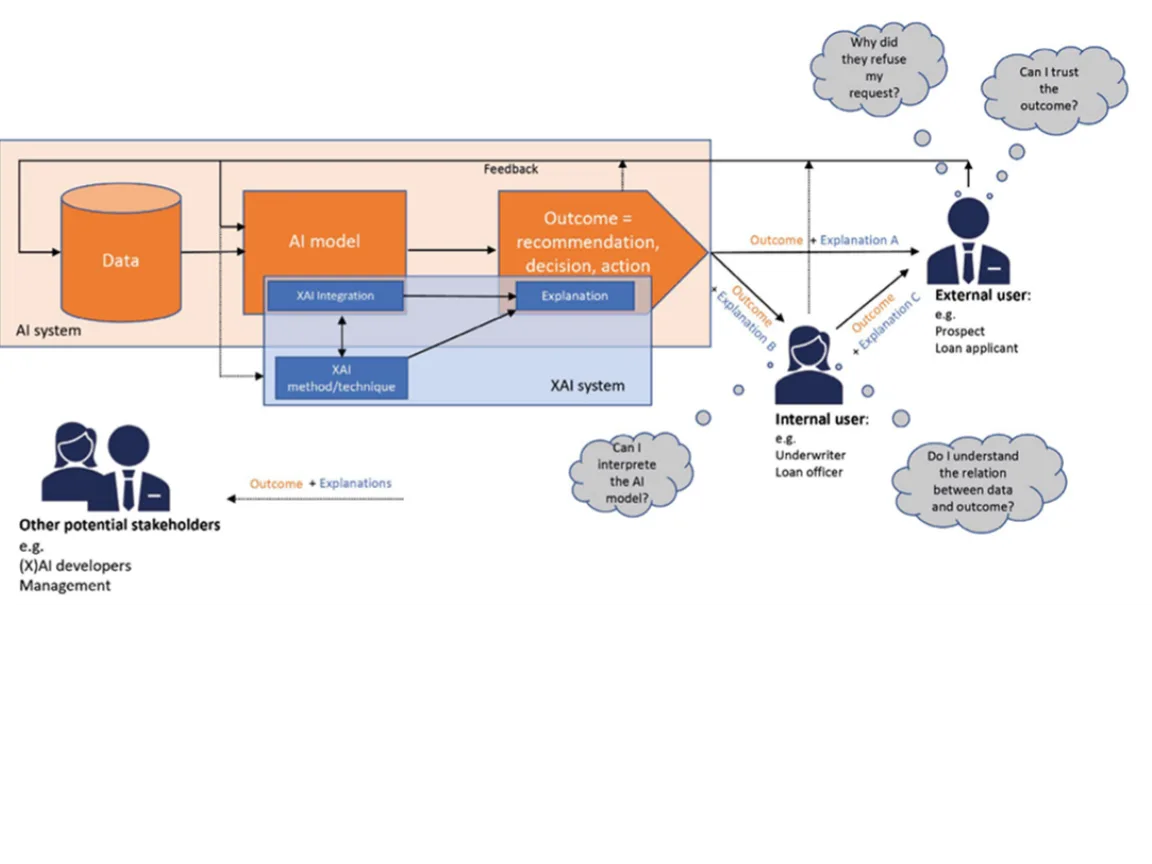
One of the most important insights from our research is that not everyone needs the same explanation. The checklist helps organisations develop different forms of explanation for different audiences:
- For customers: simple, understandable explanations of the factors that influenced their personal outcome
- For employees: deeper insights that help them explain decisions and adjust them where needed
- For regulators: detailed technical documentation demonstrating that the system meets regulations and ethical standards
- For developers: technical explainability that helps with debugging and improving models
Beyond the financial sector: universal principles for XAI
Although the whitepaper focuses on financial applications, the principles are broadly applicable. Whether it concerns healthcare, staff selection or energy management, every sector where AI supports decisions can benefit from a structured approach to explainability.
The core principles remain the same:
- Transparency is not a tick-box but a process: explainability must be considered and implemented in every phase of the AI project
- Context is king: the explanation must be tailored to the specific user and situation
- Balance between complexity and usability: a perfect technical explanation that no one understands holds little value
The future of XAI: where technology and human understanding meet
The real challenge in XAI lies not only in the technology, but in translating complex model explanations into understandable insights. This calls for a multidisciplinary approach in which data scientists, domain experts, designers and end users work together. At Researchable, we believe that this bridge between technology and human understanding is the key to responsible AI innovation. By putting transparency and explainability at the centre, we build not only better AI systems, but also the trust needed to implement this technology successfully.
Start with explainable AI today
Curious how your organisation can benefit from a more transparent and explainable approach to AI? The full whitepaper "A Checklist for Explainable AI in the Financial Sector" offers concrete tools to get started.

Take the first steps towards AI that is not only powerful, but also understandable and trustworthy.
Want to know more about how Researchable can support your organisation in implementing explainable AI? Get in touch with us for a no-obligation conversation.
Frequently asked questions
What is Explainable AI (XAI)?
Explainable AI makes the decision-making processes of AI models understandable and transparent. It turns opaque 'black box' models into systems whose outcomes users and regulators can verify.
Why does XAI matter in the financial sector?
In the financial sector, AI makes decisions with direct impact, such as approving a mortgage or detecting fraud. Without transparency, distrust arises among end users and organisations run into compliance problems with regulation such as the AI Act.
Which three levels make up the XAI checklist?
The checklist works at organisation level (defining the XAI philosophy and governance), at use case level (applying explainability per project phase) and at monitoring level (continuously evaluating as models change).
Which partners did Researchable develop the whitepaper with?
Researchable worked together with Hogeschool Utrecht, Floryn and De Volksbank, with support from the Taskforce for Applied Research SIA.
Is the XAI approach only suitable for financial services?
No. The approach applies more widely than financial services. The core principles revolve around implementing explainability as a process and communicating it in a context-specific way per stakeholder.