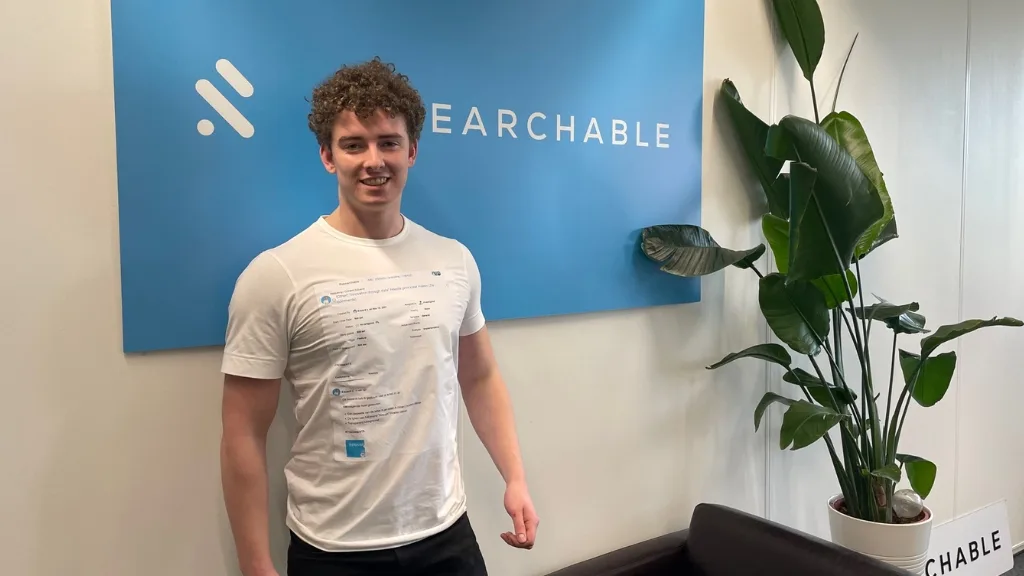

Developer Max Verbeek built a prediction model at the UMCG that uses clinical data to predict how long a kidney lasts after transplantation.
In brief
- Max Verbeek built a prediction model at the UMCG that predicts how long a kidney lasts after a transplant, from 1 year after the operation.
- The model uses clinical data the hospital already collects anyway, such as age, medication use, weight and smoking behaviour of both the patient and the donor.
- Unlike common Cox regression models, this accelerated failure time (AFT) model predicts a concrete lifespan and, through bootstrap aggregating, indicates how reliable that prediction is.
- A next step is a federated learning framework, which lets hospitals train a model together without exchanging data with one another.

Our developer Max Verbeek recently graduated as a computer scientist at the University of Groningen. He did his graduation project at the UMCG, where he built a prediction model to predict kidney failure after a kidney transplant. Max received a 9 for his project.
Making use of clinical data
An important question after a transplant is how long the kidney will last. Patients naturally want to know this, and it also helps to be able to provide adequate care. That is useful, because if you see that the kidney will not last much longer, you can go on the waiting list straight away. That is why it is important to be able to predict when, after the operation, the kidney will fail.
Max Verbeek, developer
For his research, Max worked together with Dr George Azzopardi of the RUG and Tamas Szili-Torok of the UMCG. Together they built a model that uses clinical data to predict how long the kidney will last. The nice thing about this model is that it uses data the hospital already collects anyway. Think, for example, of age, medication use, weight and whether the patient smokes. This is collected from both the patient and the donor patient.
The nice thing about that is that we can use the model in a very accessible way. People do not have to undergo any nerve-racking tests or collect extra data.
Max Verbeek
A unique prediction model
For his graduation project, Max built and validated the model on data from the UMCG. What makes this new model unique is that it can very reliably predict the lifespan of the kidney, from 1 year after the transplant. They do this using an accelerated failure time (AFT) model. Models from other research are often based instead on survival analysis (Cox regression). Those are often harder for people to understand, because they indicate the probability of failure after a certain number of years in steps. Max: "As a patient, what you want to know is how long your kidney will last. A percentage like that says very little."
The model is also special because it indicates the reliability of the estimate. It does this using the 'bagging approach', or bootstrap aggregating. Max: "That means we trained a great many small versions of the model on subsets of data. This gives us a lot of predictions. By looking at the grouping of predictions, we can see how reliable the final prediction is." This method is fairly new and unique: you get not only the prediction, but also its accuracy.
Besides wanting to know the lifespan of the kidney, you probably also want to know what influences it. That is also possible with this model, Max says. "We build the models using boosted decision trees (XGBoost). That is really cool. You can then look at the branches of all those decision trees to see which branches have the most impact. This gives good insight into which variables have the greatest influence on kidney failure."
Next steps
The model has now been built and tested on the data of the UMCG. An important next step is to test the model with much more data, so that it becomes more accurate. Because it is often difficult for hospitals to exchange data with one another, Max and his research group are now working on setting up a federated learning framework. This lets you train a model together with several parties without exchanging the data itself. The more people take part, the better the model becomes.
That is great for research into kidney failure, but of course it can also be used far more broadly.
Max Verbeek
For his research, Max programs in Python, but the plan is to eventually also make an R package. Many researchers work with R, so the model could then be used more widely.
Real implementation in healthcare will still take a while, Max thinks. But the framework they are now setting up can make it much easier in the future to train and implement prediction models. And patients benefit from that too.
Frequently asked questions
What does Max Verbeek's prediction model predict?
It predicts how long a kidney lasts after a transplant, from 1 year after the operation. This tells patients and care providers when the kidney is likely to fail, so adequate care can be arranged in time, such as placement on the waiting list.
Which data does the model use?
The model uses clinical data the hospital already collects, such as age, medication use, weight and whether someone smokes. This data comes from both the patient and the donor, so patients do not have to undergo any extra tests.
Why does the model use an accelerated failure time (AFT) model instead of Cox regression?
An AFT model gives a concrete lifespan for the kidney, whereas Cox regression indicates a failure probability after a number of years in steps. For patients, an expected lifespan is easier to understand than such a percentage.
How does the model indicate the reliability of a prediction?
The model trains many small versions on subsets of the data through bootstrap aggregating (the bagging approach), which produces many predictions. By looking at the spread of those predictions, it shows how reliable the final outcome is.
What is the role of federated learning in this research?
With a federated learning framework, several hospitals can train a model together without exchanging the underlying data. The more parties take part, the more accurate the model becomes.