In brief
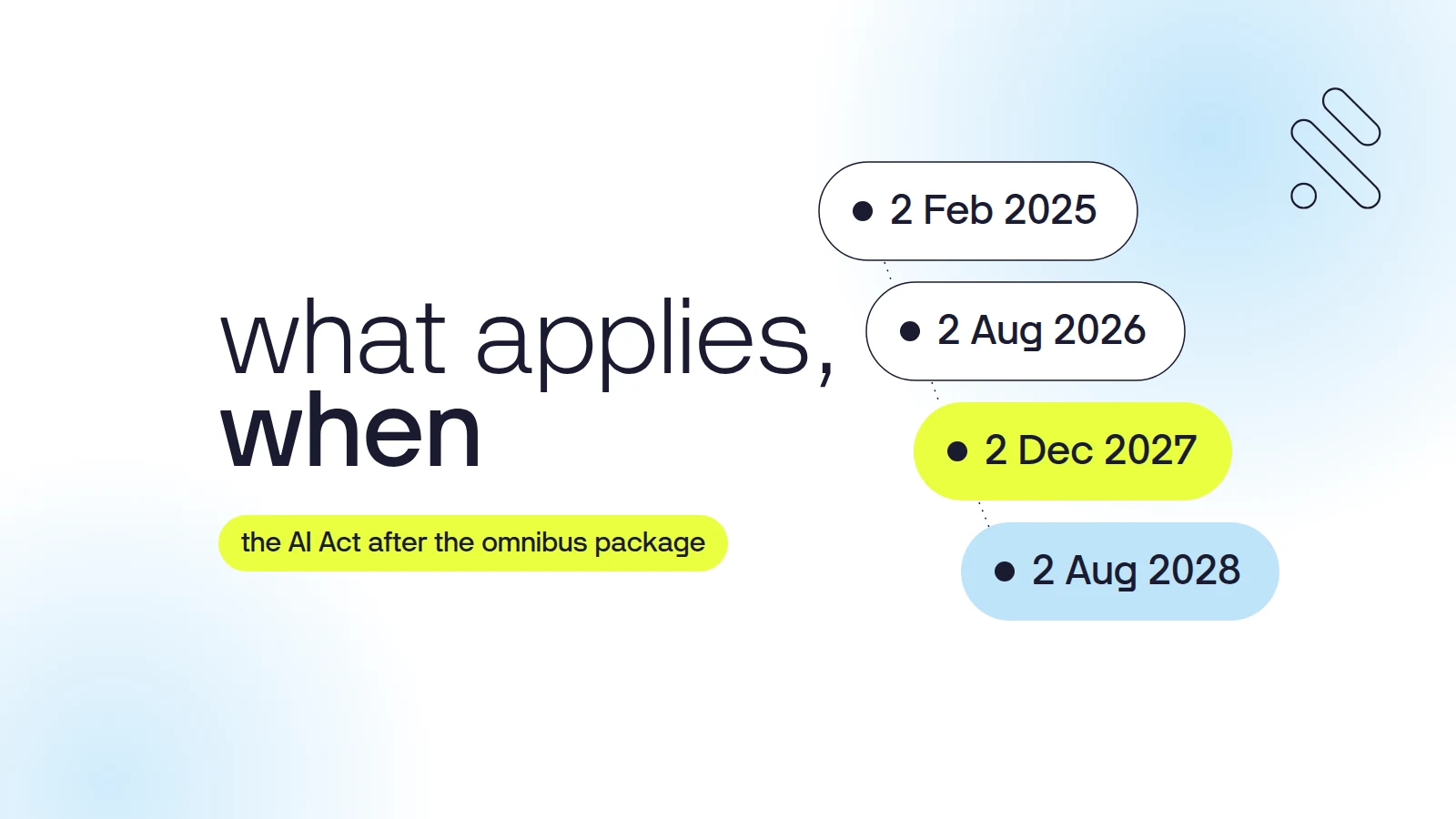
- The AI Act has applied since 2 August 2026, but not yet in full. The prohibited practices (except two added later) and the AI literacy obligation have applied since 2 February 2025, and the rules for general-purpose AI models since 2 August 2025.
- The requirements for high-risk AI systems in Annex III of the AI Act apply from 2 December 2027. According to the Dutch government's Algoritmekader, that date was previously 2 August 2026 and the AI omnibus package moved it.
- For high-risk AI in products, Annex I of the AI Act, the requirements apply from 2 August 2028.
- High-risk AI systems intended for public authorities that are already on the market or in use before the requirements apply must comply with the AI Act by 2 August 2030 at the latest.

Status on 20 November 2026: the AI Act has applied since 2 August 2026, but not yet in full. The requirements for high-risk AI systems apply from 2 December 2027 for the use cases in Annex III and from 2 August 2028 for AI in products. The AI omnibus package pushed both dates back.
The dates of the AI Act at a glance
The dates come from Article 113 and Article 111 of the AI Act, as amended by the omnibus package. The Dutch government keeps its own overview in the Algoritmekader (the Dutch government's algorithm framework). That overview differs on one point: it lists the transparency requirement under the high-risk dates, while according to Article 113, Article 50 has applied since 2 August 2026. This table follows the law.
| Date | What starts to apply | For whom |
|---|---|---|
| 2 February 2025 | The prohibition of the practices in Article 5 and the AI literacy obligation. | Providers and deployers of AI systems |
| 2 August 2025 | The rules for general-purpose AI models, the governance framework and the penalty provisions, except Article 101. | Providers of general-purpose AI models; member states and supervisory authorities |
| 2 August 2026 | The general application of the AI Act: everything without its own date, including the transparency obligations in Article 50. | Providers and deployers of AI systems |
| 2 December 2026 | Two prohibitions added by the omnibus package: AI systems that, without consent, create or alter realistic intimate or sexually explicit images, video or audio of an identifiable person, and AI systems that create or alter material or depictions within the meaning of the directive on combating the sexual abuse of children (Directive 2011/93/EU). Also the deadline for Article 50(2) for generative systems already on the market before 2 August 2026. | Prohibitions: providers and deployers. Article 50(2): providers of generative AI systems |
| 2 August 2027 | General-purpose AI models already on the market before 2 August 2025 must comply. | Providers of those models |
| 2 December 2027 | The requirements for high-risk AI systems in Annex III, including the fundamental rights impact assessment (FRIA). | Providers and deployers of those systems |
| 2 August 2028 | The requirements for high-risk AI in products in Annex I. | Providers and deployers of those systems |
| 2 August 2030 | High-risk AI systems intended for use by public authorities that are already on the market or in use before the high-risk requirements apply must comply. | Providers and deployers of those systems |
Not in the table: 31 December 2030 for AI in the large-scale European IT systems in Annex X, and 27 July 2026 for the amendments to other European legislation (Articles 102 to 110).
What the omnibus package changed
The AI omnibus package postponed the requirements for high-risk AI systems. For the use cases in Annex III, the date is now 2 December 2027; according to the Algoritmekader, it was previously 2 August 2026. For AI in products, the date is now 2 August 2028, where the original text said 2 August 2027.
The package also added rules. From 2 December 2026, two additional prohibitions apply, with conditions in Article 5, paragraphs 1a and 1b, and generative systems already on the market have until that date to comply with Article 50(2). The rule on the DPIA in relation to the FRIA has been amended; we describe that in our article on the fundamental rights impact assessment.
When existing AI systems must comply
For a high-risk AI system that is already on the market or in use before the requirements apply, the AI Act applies under Article 111(2) only if its design is significantly changed afterwards. The prohibitions in Article 5 always apply. Systems intended for public authorities have an end date: providers and deployers must comply by 2 August 2030 at the latest.
The Algoritmekader names an exception: high-risk AI systems already in use at government organisations on 2 December 2027 only have to meet the requirements in 2030.
Who supervises the AI Act in the Netherlands
Dutch supervision of the AI Act is not yet laid down in law. The Dutch cabinet put the proposal for the Uitvoeringswet AI-verordening (the Dutch AI Act implementation act) out for consultation on 20 April 2026. In that proposal, several existing supervisory authorities work together, and the Autoriteit Persoonsgegevens (AP, the Dutch Data Protection Authority) and the Rijksinspectie Digitale Infrastructuur (RDI, the Dutch Authority for Digital Infrastructure) get a coordinating role, according to the Dutch government. On 13 October 2026, the Autoriteit Persoonsgegevens was the intended supervisory authority but had not yet been designated, according to Dutch IT Channel. The Algoritmekader describes the national supervisory authorities in the Netherlands as still being set up. The fines under the AI Act are in our Monthly AI Update of August 2026 (in Dutch).
What to do with the AI Act timeline
- 1Set up a register of every AI system in your organisation, including the models in purchased software. In our monthly update of August, we called this the work you can do now, even though the high-risk requirements start later.
- 2Determine your role and the risk class for each system. The Dutch government offers the Beslishulp AI-verordening (an AI Act decision aid) for this.
- 3Put the date that belongs to each system in your planning. For a new high-risk system in Annex III, that is 2 December 2027. For a high-risk system intended for public authorities that is already in use by then, it is 2 August 2030 at the latest, unless its design is significantly changed before then.
- 4If the fundamental rights impact assessment applies to you, look at the draft template from the European Commission. You can respond until 15 January 2027 inclusive; the obligation itself applies from 2 December 2027.
The standards and laws we assess systems against are on our page about security.
Changes
- 20 November 2026: first version, with the dates as they apply after the AI omnibus package.
Frequently asked questions
When does the AI Act take effect?
The AI Act has applied since 2 August 2026, but not everything applies from that date. Parts applied earlier: the prohibited practices (except two added later) and the AI literacy obligation since 2 February 2025, and the rules for general-purpose AI models since 2 August 2025. The requirements for high-risk AI systems follow on 2 December 2027 and 2 August 2028.
From when do the requirements for high-risk AI systems apply?
For high-risk AI systems in Annex III of the AI Act, the requirements apply from 2 December 2027. For high-risk AI in products, Annex I, that is 2 August 2028. Both dates are in Article 113 of the AI Act, as amended by the AI omnibus package.
What did the AI omnibus package change about the dates?
The AI omnibus package postponed the requirements for high-risk AI systems to 2 December 2027 (Annex III) and 2 August 2028 (AI in products). According to the Dutch government's Algoritmekader, the first date was previously 2 August 2026. The package also added two prohibitions, which apply from 2 December 2026.
Do AI systems already in use also have to comply with the AI Act?
For a high-risk AI system that is already on the market or in use before the requirements apply, the AI Act applies under Article 111(2) only if its design is significantly changed afterwards. The prohibitions in Article 5 always apply. Systems intended for public authorities have an end date: there, providers and deployers must comply by 2 August 2030 at the latest.
Who supervises the AI Act in the Netherlands?
Supervision of the AI Act in the Netherlands is not yet laid down in law. In April 2026, the Dutch cabinet proposed a system in which several existing supervisory authorities work together and the Autoriteit Persoonsgegevens (the Dutch Data Protection Authority) and the Rijksinspectie Digitale Infrastructuur (the Dutch Authority for Digital Infrastructure) coordinate. On 13 October 2026, the Autoriteit Persoonsgegevens had not yet been formally designated.