In brief
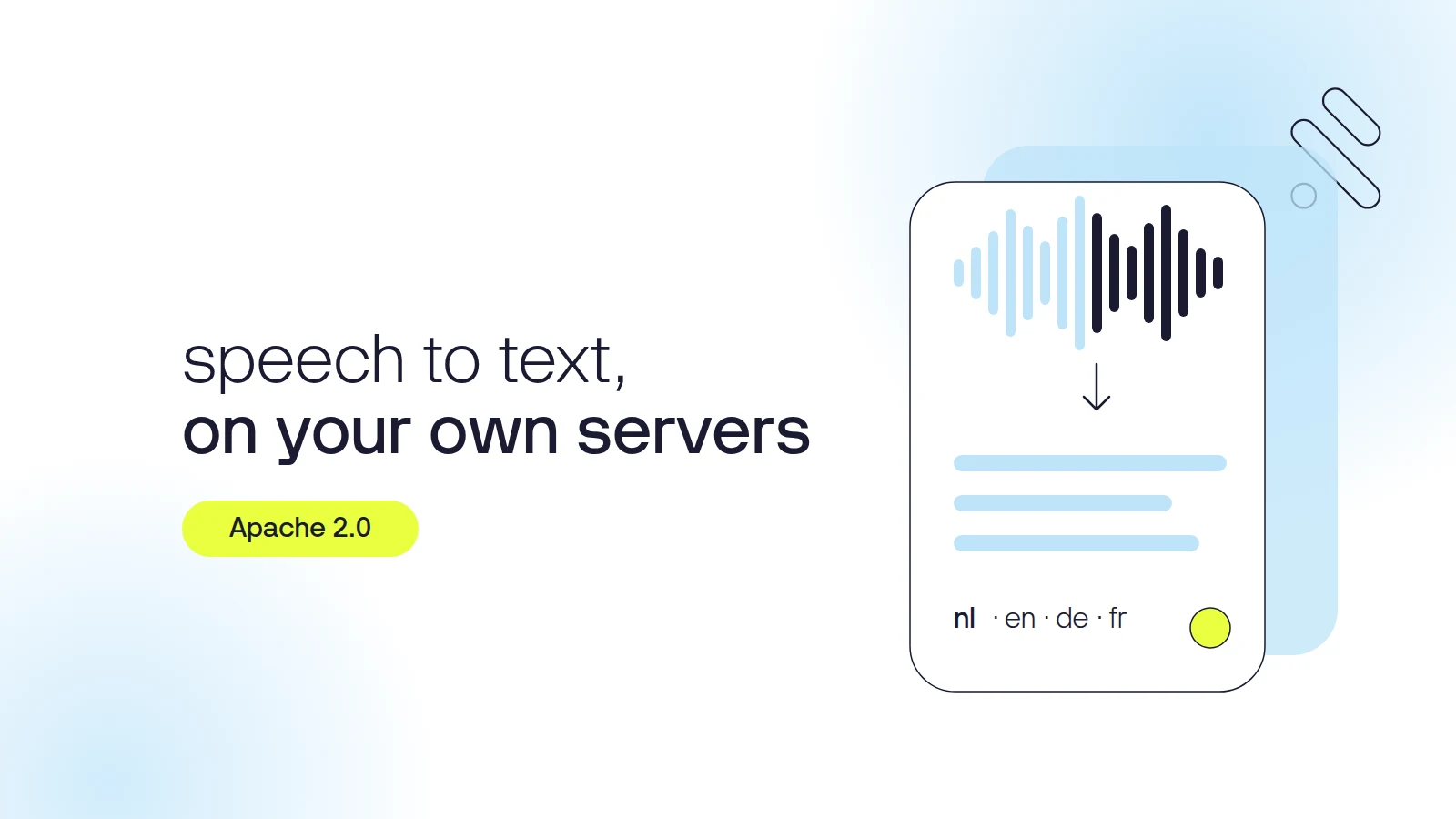
- Reson8 from Amsterdam released the speech recognition model Rumble-2-Flash on 18 November 2026 under Apache 2.0: 0.5 billion parameters, more than 40 languages, and free to run on your own servers.
- Rumble-2-Flash also recognises Dutch. According to the Reson8 model card, the model makes an average of 6.78 percent word errors in Dutch on the Open ASR Leaderboard (version of 18 November 2026).
- Through the Reson8 API, Rumble-2-Flash costs from 1 cent per hour of audio on the Scale plan, but Reson8 describes that service as meant for testing and non-critical use, without an SLA. The pricing page does not state separately where that audio is processed.

Reson8, a speech company from Amsterdam, released the model Rumble-2-Flash on 18 November 2026. It converts speech into text, has 0.5 billion parameters and is available with open weights under the Apache 2.0 licence on Hugging Face. That is stated in the announcement on the Hugging Face blog.
What Rumble-2-Flash does
- More than 40 languages with automatic language detection; the model card lists 45, including Dutch. You can also fix the language.
- Settings for numbers as digits or words, and for keeping filler words such as um and uh and repeated words.
- Runs without custom code in the common libraries Transformers and vLLM. The model is built on Qwen3-ASR-0.6B.
- According to the announcement, it processes an hour of audio in about half a second, measured with full batches on a heavy data centre GPU (H200). The Reson8 homepage more cautiously speaks of seconds.
According to the announcement, the model makes an average of 6.96 percent errors on the multilingual track of the Open ASR Leaderboard, across nine languages. For Dutch, the model card lists an average of 6.78 percent, measured on three public datasets of read-aloud sentences and audiobooks. These figures have not been independently verified.
What Rumble-2-Flash costs and where your audio stays
Running Rumble-2-Flash yourself costs no licence fee. Audio you process on your own servers does not leave your own environment. If you do not want to run the model yourself, you can use it through the Reson8 API. The pricing page lists these rates, excluding VAT, within a subscription of EUR 20 (Launch) or EUR 100 (Scale) per month. There is also a free plan (Build) with monthly credits, no payment card required.
| Option | Price per hour of audio | What Reson8 says about it |
|---|---|---|
| Run Rumble-2-Flash yourself | Free (Apache 2.0) | On your own servers or device. |
| Rumble-2-Flash through the API | EUR 0.0114 (Launch), EUR 0.01 (Scale) | The pricing page only mentions recorded audio. Meant for testing and non-critical use, outside the SLA. |
| Rumble-2 through the API | From EUR 0.14 (Scale), live from EUR 0.21 | The larger model. Runs on Reson8's own GPUs in the Netherlands; audio and transcripts stay in the EU. |
For Rumble-2-Flash through the API, the pricing page does not state separately where the audio is processed. That page explicitly links EU-only processing and no data storage to Rumble-2. On its homepage, Reson8 promises processing on GPUs in the EU in general, without storing audio.
Processing confidential audio on your own hardware
In our Monthly AI Update of October (in Dutch) we wrote that meetings often contain an organisation's most sensitive information, and that healthcare, legal and government are better off processing confidential audio on their own hardware than through a cloud note taker. With a small open model that recognises Dutch, that is cheaper to try out.
What you can do now
- 1Test on your own recordings. The scores on the model card come from public datasets; phone calls, dialect and jargon from your own sector may turn out differently.
- 2Choose to run it yourself if the audio is confidential. Then you decide where the data is stored and for how long.
- 3If you need a hosted service with guarantees, look at Rumble-2 on an Enterprise contract or another provider with an SLA. According to the pricing page, the Reson8 SLA only applies to Rumble-2, and only on Enterprise.
How to set up models under your own control is covered under AI infrastructure.
Frequently asked questions
Can I use Rumble-2-Flash in the Netherlands?
Yes. The weights are available under Apache 2.0 on Hugging Face, so you can download the model and run it on your own servers. Reson8, a company from Amsterdam, also offers the model through an API. According to the model card, Rumble-2-Flash recognises 45 languages, including Dutch; you can also fix the language.
What does Rumble-2-Flash cost?
Running it yourself costs no licence fee, only your own computing power. Through the Reson8 API it costs EUR 0.0114 per hour of audio on the Launch plan (EUR 20 per month) and EUR 0.01 on Scale (EUR 100 per month), excluding VAT. Reson8 describes that API as meant for testing and non-critical use, outside the SLA.
Where is my audio processed with Rumble-2-Flash?
If you run the model yourself, the audio stays in your own environment. For the Reson8 API, the pricing page does not state separately where Flash audio is processed. For the larger Rumble-2, Reson8 reports processing on its own GPUs in the Netherlands, without audio or transcripts leaving the EU.