In brief
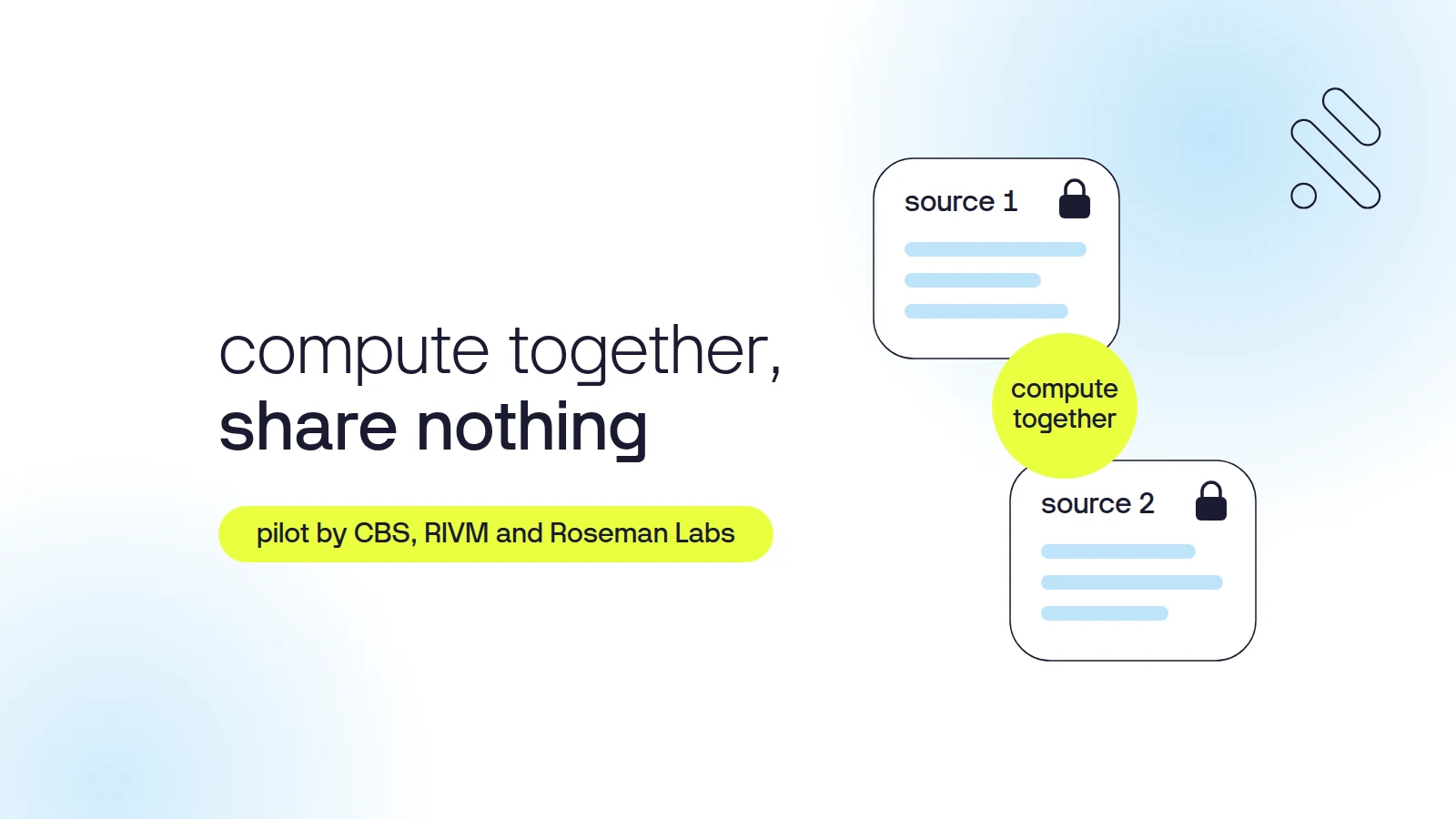
- Between 2022 and early 2025, CBS, RIVM and Roseman Labs tested whether two government organisations can jointly run an analysis on data they cannot simply hand over to each other. CBS announced the result of the pilot on 12 November 2026.
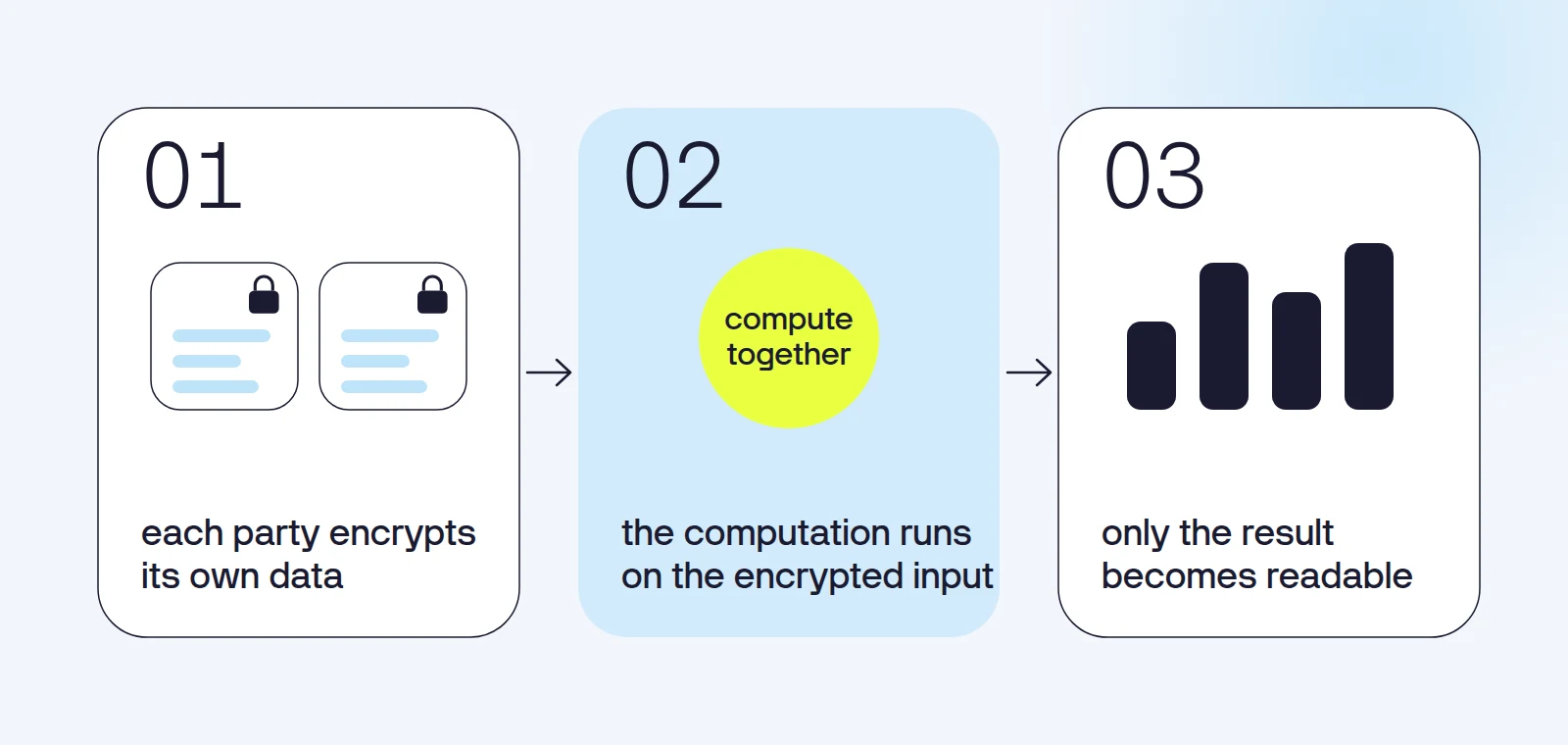
- The technique in the CBS pilot is called secure multi-party computation (MPC): each party encrypts its own data, the computation runs on the encrypted input, and only the result becomes readable.
- The CBS pilot with MPC ran on fictitious data. According to the evaluation, the privacy and security requirements were met and computing on encrypted data is technically feasible at a relevant scale. CBS is still looking at how to get to a production-ready environment.
- MPC fits research that runs for a longer time or recurs and that needs sensitive data from several organisations. For development and testing, synthetic data is the lighter choice than MPC, and for training one model across several locations, federated learning is.

CBS (Statistics Netherlands), RIVM (the Dutch National Institute for Public Health and the Environment) and Roseman Labs have shown that two government organisations can jointly run an analysis on data they cannot simply hand over to each other. The pilot used secure multi-party computation (MPC) and ran from 2022 to early 2025. CBS announced the result on 12 November 2026.
What CBS, RIVM and Roseman Labs tested
The question in the pilot was how much sugar and fat is consumed per area. RIVM contributed data on food products, CBS contributed sales figures. Both files are confidential and, according to CBS, could not be combined otherwise.
With MPC, each party encrypts its own data. The computation runs on the encrypted input of both parties, and only the result becomes readable. Neither party gets to see the other's file.
According to CBS, the analysis itself was relatively simple, and the added value lies in applying the technique reliably within government. That requires a complex IT integration, fitting in the preconditions of both organisations, and conditions in the processing that safeguard privacy.
What the MPC pilot shows, and what it does not show yet
CBS names two outcomes of the evaluation. The required privacy and security criteria were met, and analyses on encrypted data are technically feasible at a relevant scale. Fannie Cobben, director of innovation in socio-economic and spatial statistics at CBS, puts it like this: "Secure multiparty computation has proven itself sufficiently." (translated from Dutch)
Three caveats apply:
- The pilot ran on fictitious data.
- The requirements are those of the pilot itself. Digitale Overheid (a Dutch government website) speaks of the privacy and security requirements set within the pilot.
- CBS is still looking at how to get to a production-ready environment, and wants to put proven techniques into production step by step.
CBS calls it a new technique, but the first applications are already several years old. CBS itself mentions a project with TNO (the Netherlands Organisation for Applied Scientific Research) and Zuyderland hospital from 2018, and Roseman Labs says that the Nationaal Cyber Security Centrum (NCSC, the Dutch National Cyber Security Centre) has used MPC continuously since 2021.
Three ways to use sensitive data without sharing it
MPC is one of the techniques that CBS calls privacy-preserving techniques. If you want to use sensitive data without sharing it, compare three of them side by side, because each one solves a different problem.
| Technique | What happens | Fits | Note |
|---|---|---|---|
| Computing on encrypted data (MPC) | The readable data stays at the source and only the result is released. | A fixed question you want to answer again and again with another organisation, such as a joint statistic. | It requires a connection between the systems of all participants. |
| Synthetic data | A model creates an artificial dataset that approximates the statistical properties of the original and should not contain records of real people. | Development and testing. | You cannot use it to link records from two organisations to each other. |
| Federated learning | The model goes to the data; only what the model learns leaves the location. | Training one model across several hospitals or sites. | In the common form, all participants need comparable data and their own computing power. |
What we see ourselves when working with sensitive data
We know synthetic data from our own work. We helped build the Syntho platform, software that generates synthetic data so that organisations can work with data without putting privacy at risk. Several companies and government institutions now work with synthetic data.
The project Medicijnresten uit Water (pharmaceutical residues from water) shows how two kinds of data say more together than apart. There we put prescription data from general practitioners next to measurements of pharmaceutical residues in the wastewater of two neighborhoods in the Dutch town of Drachten. The dashboard shows the prescription data per type of medication, broken down by year, age group and sex.
The dashboard can be applied to new datasets from more general practitioners and healthcare institutions. If those are added, projects like this face the same question as CBS: how do you put data side by side without handing it over.
When to choose MPC, and how to start
- 1Start with the question. MPC pays off for research that runs for a longer time or recurs. Jan de Bruin, innovation manager at RIVM, says in the CBS article that you do not set up such a system for a short-term study.
- 2Practice with fictitious data. The CBS and RIVM pilot ran on that too. This way you test the connection and the agreements before a real record goes through.
- 3Record who may ask which question. The encryption protects the input; which results may be released is up to you. The GDPR continues to apply as long as the input contains personal data.
How privacy and data use go together is covered in Privacy and ethics in data analysis. Linking sources itself is the subject of data architecture and engineering.
Frequently asked questions
What is secure multi-party computation?
Secure multi-party computation (MPC) is a cryptographic technique that lets several parties jointly run a computation on their combined data, without any of them seeing the other's data. Each party encrypts its own input and only the result becomes readable. What that result itself reveals about the input is something you assess separately.
Is MPC the same as anonymisation?
No. With anonymisation you change the data itself so that it can no longer be traced back to a person, and then you hand it over. With MPC you do not hand over the data in readable form: it only enters the computation encrypted. Only the computed result is released.
Does the GDPR still apply when you work with MPC?
Assume it does. MPC limits what parties see of each other, but if the input contains personal data, that data is still being processed. A legal basis, a clear purpose and agreements on which results may be released remain necessary. According to CBS, the European supervisory authorities, including the European Data Protection Board, are following the development with interest.
Is MPC already used in practice in the Netherlands?
Yes, according to Roseman Labs. Toon Segers of that company says in the CBS article that the Nationaal Cyber Security Centrum has used the technique continuously since 2021, and mentions the municipality of Rotterdam, which according to him won the Nederlandse Privacy Award (Dutch Privacy Award) with a continuous monitor for equal opportunities. CBS itself is still looking at how to get to a production-ready environment.
When do you choose synthetic data instead of MPC?
Choose synthetic data if you want to develop or test without using real data. Synthetic data is an artificial dataset that approximates the statistical properties of the original. For an exact result on the real data of two organisations combined, MPC is a suitable technique.