In brief
- On 16 November 2026, the European Commission published a draft template for the fundamental rights impact assessment (FRIA) under Article 27 of the AI Act. You can respond to the draft until 15 January 2027 inclusive.
- The fundamental rights impact assessment is mandatory for bodies governed by public law and private organisations that provide public services, when they deploy a high-risk AI system listed in Annex III of the AI Act. The fundamental rights impact assessment also applies to organisations that deploy such a system for the credit assessment of natural persons, or for risk assessment and pricing in life and health insurance. Systems that serve as a safety component in critical infrastructure are exempt.
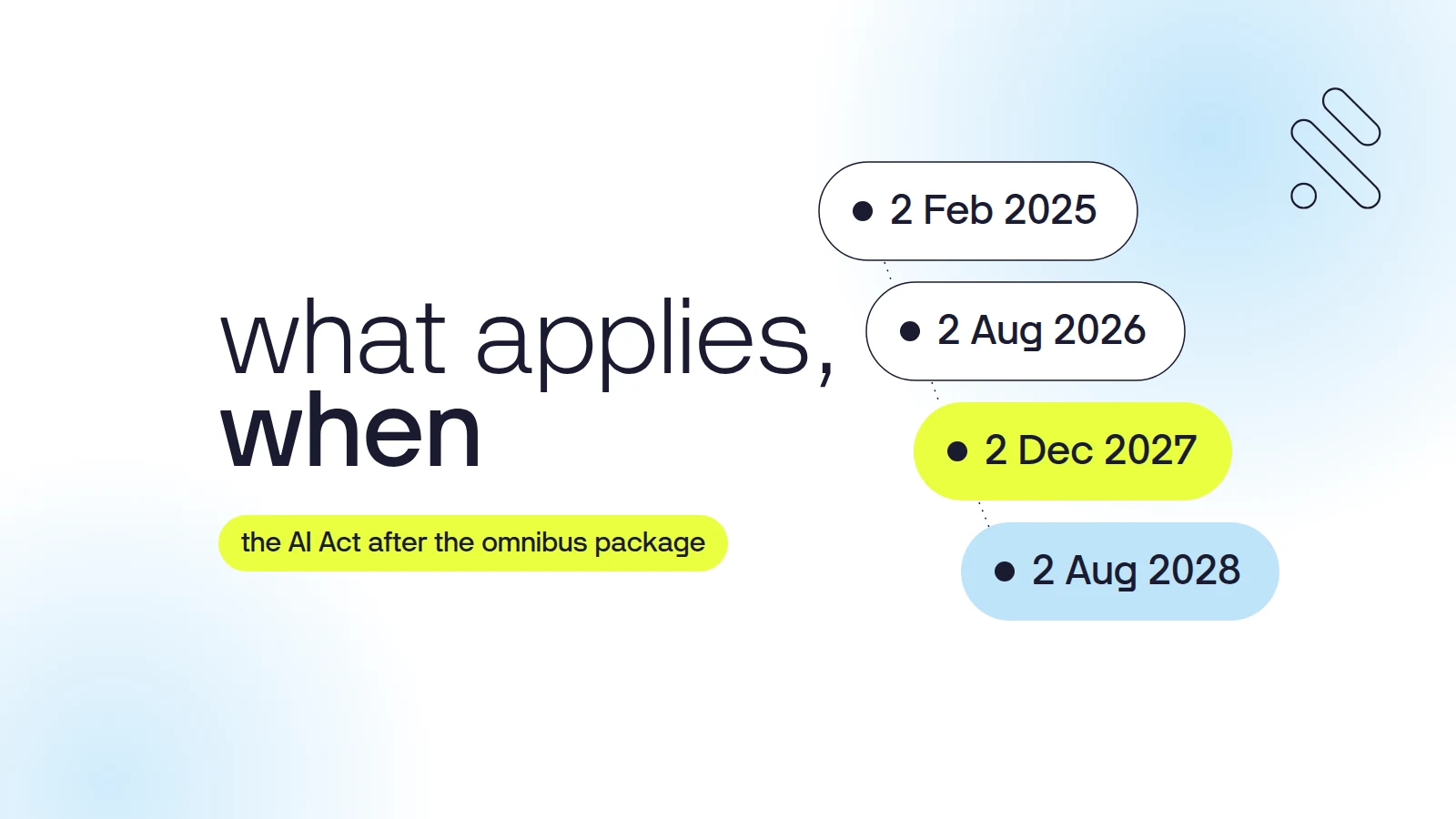
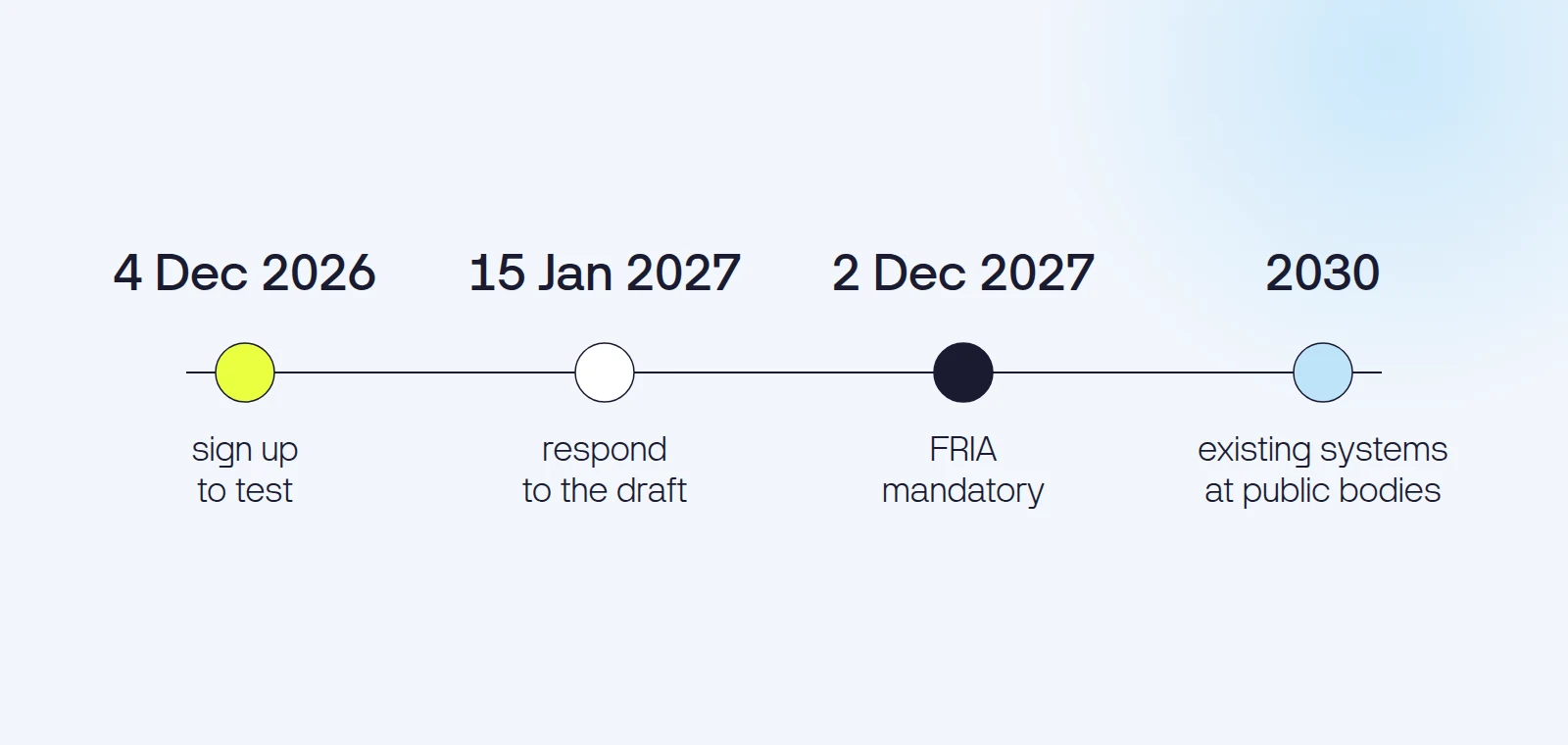
- The fundamental rights impact assessment becomes mandatory from 2 December 2027. For high-risk systems that government organisations already use on that date, the Dutch government's Algoritmekader mentions 2030.
- Once the Commission's template for the fundamental rights impact assessment is final, it becomes the mandatory format. The organisation that deploys the system reports the outcome to the market surveillance authority.
- The Dutch IAMA was updated in February 2026 and now fits the AI Act better, but it is not the European template for the fundamental rights impact assessment. In the fundamental rights impact assessment, you may refer to a DPIA you already have.

On 16 November 2026, the European Commission published a draft template for the fundamental rights impact assessment (FRIA) under Article 27 of the AI Act. Governments and other organisations that provide public services must carry out this assessment from 2 December 2027 when they deploy a high-risk AI system. You can respond to the draft until 15 January 2027 inclusive.
Who must carry out the fundamental rights impact assessment
The law calls it an assessment of the impact on fundamental rights, usually abbreviated to FRIA. The obligation lies with the organisation that deploys the system. The AI Act calls it the deployer. The provider is the party that places the system on the market or puts it into service under its own name. That is often the supplier, but not always the party that builds it.
Article 27 names two groups:
- Bodies governed by public law and private organisations that provide public services, when they deploy a high-risk system listed in Annex III. Recital 96 of the law gives education, healthcare, social services, housing and the administration of justice as examples of such services.
- Organisations that deploy a high-risk AI system to evaluate the creditworthiness or credit score of natural persons (detecting financial fraud is excluded), or for risk assessment and pricing in life and health insurance for natural persons.
One area from Annex III falls outside the assessment: AI as a safety component in critical infrastructure, including the supply of water, gas, heating and electricity. Such a system does remain high-risk, with the other requirements that come with it.
What the fundamental rights impact assessment contains
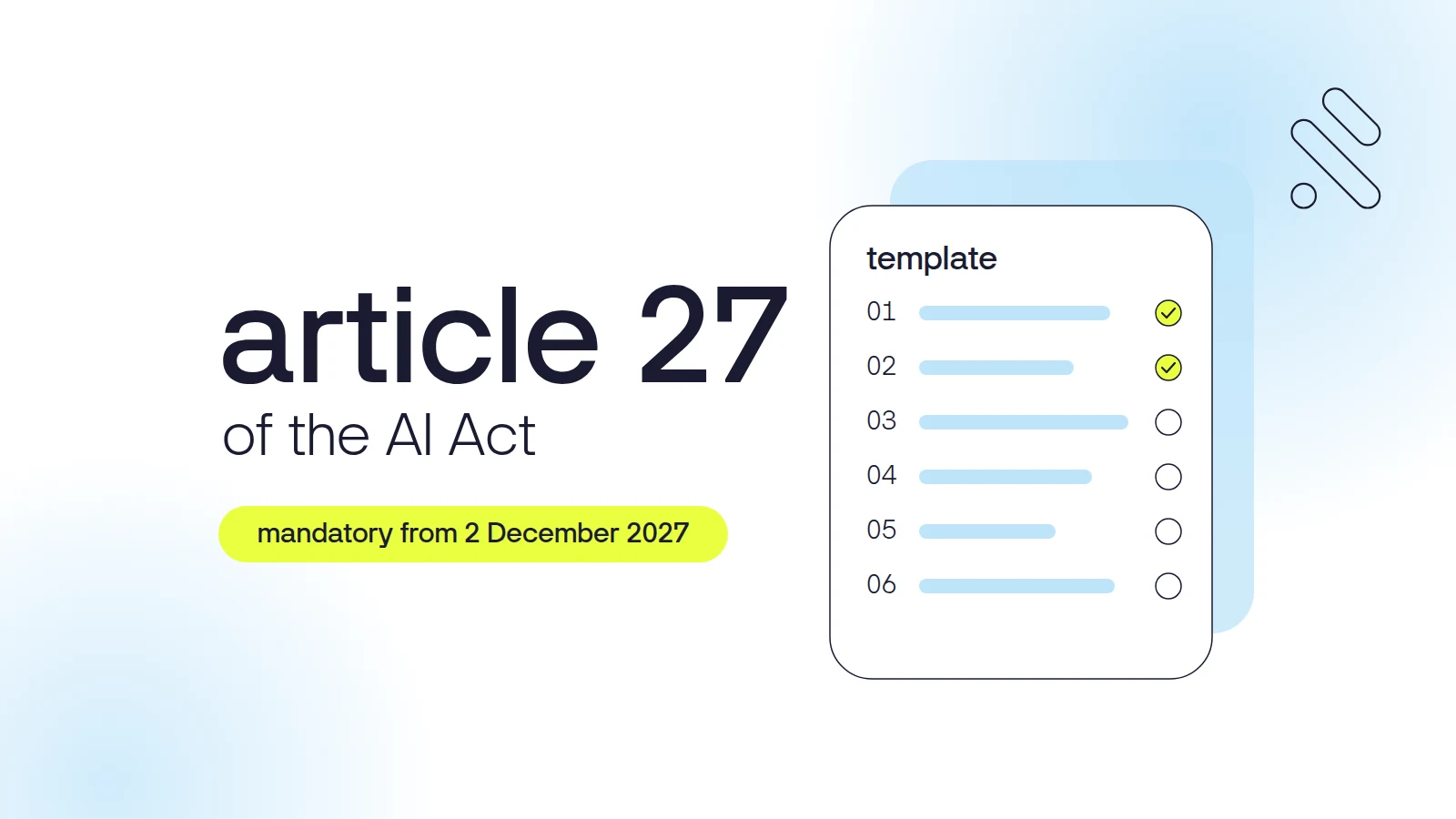
Article 27 prescribes six elements, and the Commission's template follows that structure:
- 1The processes in which you use the system, in line with the intended purpose the provider has set for it.
- 2Over what period and how often you intend to use the system.
- 3Which groups of people are likely to be affected by its use, in the context in which you deploy it.
- 4Which risks of harm those groups face. You take into account the information from the provider.
- 5How human oversight is arranged, according to the instructions for use.
- 6What you do if a risk materialises, including internal governance and a complaints procedure.
You carry out the assessment before first use and update it when one of the elements changes. In similar cases, you may rely on an earlier assessment or on an assessment by the provider.
What the Commission is asking for now
The AI Office drew up the template with input from the European Union Agency for Fundamental Rights. The draft comes with an explanatory notice on who must carry out the assessment, when, and how the obligation relates to the obligations of the provider. There are two deadlines:
- Up to and including 4 December 2026, organisations that will fall under Article 27 can sign up to test the template on one of their own systems. The AI Office supports the test and may make a selection if many organisations sign up.
- Up to and including 15 January 2027, anyone can respond to the draft.
Once the template is final, you must use it for the assessment and report the outcome to the market surveillance authority. Article 27 has one exception to that notification, for the cases in Article 46(1). The Commission will also make the template available as a fill-in tool on the AI Act Single Information Platform.
When the fundamental rights impact assessment applies
The obligation applies from 2 December 2027. That date was previously 2 August 2026 and was moved by the AI omnibus package, according to the Dutch government's Algoritmekader (its framework for responsible use of algorithms). For high-risk systems that government organisations already use on 2 December 2027, the Algoritmekader mentions an exception: those only need to meet the requirements in 2030.
We wrote earlier in our monthly update of August (in Dutch) that the heavier requirements for high-risk systems have moved to December 2027, along with who supervises them in the Netherlands.
How the fundamental rights impact assessment relates to the IAMA and the DPIA
Dutch government bodies already have the Impact Assessment Mensenrechten en Algoritmes (IAMA, the Dutch human rights and algorithms impact assessment). The Utrecht Data School developed it in 2021, commissioned by the Ministry of the Interior and Kingdom Relations. The February 2026 version fits the AI Act better. The Algoritmekader recommends the IAMA for high-risk AI systems and names it as a source for the requirement in Article 27.
The IAMA is a tool, and the European template will be the mandatory format. How the two fit together is not stated in the Commission's announcement or on the Algoritmekader pages. The topics overlap: according to the Algoritmekader, the IAMA focuses mainly on the impact on fundamental rights.
The law says more about the DPIA. If a DPIA you carried out under the GDPR already covers part of Article 27, you may refer to those parts in the fundamental rights impact assessment or copy them. The template must allow for this where relevant. This option was added by the AI omnibus package.
| Instrument | Comes from | For whom | Covers | Status |
|---|---|---|---|---|
| Fundamental rights impact assessment | AI Act, Article 27 | Certain organisations that deploy a high-risk AI system | The impact of the use on fundamental rights | Legally required from 2 December 2027 |
| IAMA | The Netherlands, commissioned by the Ministry of the Interior and Kingdom Relations | Government bodies | Mainly the impact on fundamental rights, for AI systems and other algorithms | Tool, recommended for high-risk AI systems |
| DPIA | GDPR, Article 35 | Anyone processing personal data with a high risk | The risks of processing personal data | Legally required when the risk is high |
What the fundamental rights impact assessment asks of the provider
The assessment lies with the organisation that deploys the system and relies on what the provider supplies. Three of the six elements refer to it: the purpose the system is intended for, the information about risks and the instructions for use for human oversight. If you have a system built to order and put it into service under your own name, you are the provider yourself under the AI Act definition, and you record that information yourself.
We build software for hospitals and municipalities, among others, such as Watch@Heart with Amsterdam UMC and VitIndex for municipalities. Whether a system is high-risk depends on what it is used for, and you determine this per system. The standards and laws we assess systems against (ISO 27001, NEN 7510 (the Dutch standard for information security in healthcare), the GDPR and the AI Act) are on our page about security.
What you can do now
- 1Determine whether you fall under Article 27. Check which AI systems you deploy and whether they are listed in Annex III. The Dutch government's Beslishulp AI-verordening (the Dutch AI Act decision aid) helps with this.
- 2Ask the provider of each high-risk system for the intended purpose, the known risks and the instructions for use. Three elements of the assessment build on them.
- 3If you want to influence the template, respond by 15 January 2027 at the latest. If you want to try it on one of your own systems, sign up by 4 December 2026 at the latest.
- 4If you already have a DPIA for the system, put it alongside: you may refer to it or copy parts of it.
Frequently asked questions
What is the fundamental rights impact assessment under the AI Act?
The fundamental rights impact assessment (FRIA) is the assessment of the impact on fundamental rights under Article 27 of the AI Act. In it, certain organisations that deploy a high-risk AI system describe what they use the system for, which groups of people are likely to be affected by it, which risks those groups face and which measures are in place.
Who must carry out a fundamental rights impact assessment?
Bodies governed by public law and private organisations that provide public services, such as in education, healthcare, social services and housing, when they deploy a high-risk AI system listed in Annex III of the AI Act. Also organisations that use such a system for the credit assessment of natural persons or for risk assessment and pricing in life and health insurance. Systems that serve as a safety component in critical infrastructure are exempt.
From when is the fundamental rights impact assessment mandatory?
From 2 December 2027, according to the European Commission. According to the Algoritmekader, that date was previously 2 August 2026 and was moved by the AI omnibus package. For high-risk systems that government organisations already use on 2 December 2027, the Dutch government's Algoritmekader mentions an exception until 2030.
Is an IAMA the same as the fundamental rights impact assessment under the AI Act?
No. The IAMA is a Dutch tool for government bodies; the February 2026 version fits the AI Act better. The fundamental rights impact assessment is a legal obligation with its own European template, which becomes mandatory once it is final. The Commission's announcement and the Algoritmekader pages do not state how the IAMA and the template fit together.
What is the difference between the fundamental rights impact assessment and a DPIA?
A DPIA comes from the GDPR and covers the risks of processing personal data. The fundamental rights impact assessment comes from the AI Act and covers all fundamental rights affected by the use of a high-risk AI system. If an existing DPIA already covers part of Article 27, you may refer to those parts in the fundamental rights impact assessment or copy them.
Does the fundamental rights impact assessment apply to water boards and drinking water companies?
Article 27 exempts AI systems that serve as a safety component in critical infrastructure, including the supply of water. Whether a system of a drinking water company or water board falls under this depends on what it is intended for. For other high-risk systems listed in Annex III, the assessment applies if the organisation is a body governed by public law or provides public services. You determine this per organisation and per system.